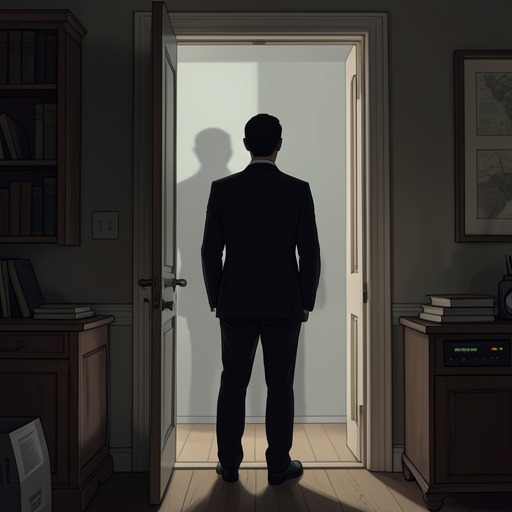
Pierce Inverarity
The Crying of Lot 49Pierce Inverarity is a California real-estate mogul whose death sets Oedipa Maas on a course through his complicated estate and into the mystery of the Tristero. He is at once an absent former lover, a far-reaching owner of property, and a possible unseen organizer of the clues Oedipa follows. The novel never settles whether his will preserved a genuine secret, staged an elaborate practical joke, or simply became the surface onto which Oedipa’s uncertainty was projected.
Identity and Estate
Inverarity is introduced through the scale and disorder of what he leaves behind. He had once lost two million dollars in his spare time, yet retained enough numerous and tangled assets to make sorting them a substantial task. Oedipa learns that she has been named executor, or, as she hesitantly puts it to herself, executrix. The law firm handling the estate has only recently found the will, although Inverarity died in the spring; its letter names Metzger as co-executor and special counsel if litigation becomes involved. Oedipa, too, was designated in a codicil dated a year earlier.
The appointment turns an intimate past into a legal and administrative obligation. Oedipa spends the afternoon trying to remember what had happened around the codicil’s date, while ordinary routines—shopping in Kinneret-Among-The-Pines, tending herbs, preparing dinner, and waiting for Mucho Maas—fail to bring the memory back at once. She eventually recalls a strange late-night call from Inverarity, whose voice shifted through a series of assumed accents and characters before settling into the voice he had used on their trip to Mazatlán. Her remembered fragment, asking him to stop, hints at the private history behind the formal appointment without explaining what he intended by it.
A Former Lover in Memory
Inverarity’s presence is first recovered as a cluster of images rather than a reliable account. Oedipa remembers a hotel room in Mazatlán, a Cornell sunrise, a Bartók concerto, and the whitewashed bust of Jay Gould that Inverarity kept on a narrow shelf over the bed. She had feared the bust might fall on them. Now she wonders, with helpless laughter, whether it had killed him. The imagined possibility is not evidence of his death’s circumstances; it shows how memory turns their shared objects into explanations after the fact.
Their intimacy had also contained distance and imbalance. Inverarity’s stamp collection had often served as a substitute for Oedipa: he could spend hours examining its thousands of colored images while ignoring her. She had not understood the fascination, and, when asked to inventory and appraise the collection, regarded the task as another headache. The stamps appear to her at first as rivals for his attention, themselves cheated by his death and soon to be divided among new owners. Her later investigation transforms that neglected collection into a possible source of evidence, making the old emotional displacement part of the mystery’s material history.
Property, Clues, and Suspicion
Oedipa’s estate work increasingly intersects with her search for the Tristero. After learning that a catalogue addendum lists a San Francisco stamp as “Tristero Rapid Post, San Francisco, California,” she notices that the book came from Zapf’s Used Books. She returns to San Narciso and checks Inverarity’s assets: the shopping center containing Zapf’s and Tremaine’s surplus store belonged to him, as did the Tank Theater. These connections do not establish that Inverarity planted the stamp or engineered the clue. They do, however, make the estate seem to touch the very places through which the mystery has surfaced.
The possible reach of his influence expands further when Oedipa considers Emory Bortz, who teaches at San Narciso College, an institution heavily endowed by the dead man. Bortz, Metzger, Genghis Cohen, Randolph Driblette, Stanley Koteks, a tattooed sailor in San Francisco, and the W.A.S.T.E. carriers she has seen all become, in her suspicion, possible “men” of Inverarity—whether bought, freely loyal, or participating in a practical joke. The thought is frightening precisely because the evidence can be read in opposed ways: an estate’s legitimate holdings and connections might explain why its owner’s name recurs, or the recurrences might point to a concealed design.
Will and Possible Intentions
The will becomes more than a document governing property. Oedipa wonders whether it represents Inverarity’s attempt to leave something organized behind after his annihilation, and whether her duty is to give life to what has persisted. She imagines herself as a device that might project meaning across a dark dome, but recognizes the obstacles: her ignorance of law, investment, real estate, and, ultimately, the dead man himself. Even the probate bond stands as a practical measure of what lies between her and the task she imagines.
Near the end, Oedipa entertains several incompatible accounts of Inverarity’s purpose. He might have encoded the Tristero in the will so that she would find it; he might have meant only to harass a former mistress; or he might have pursued some effort to survive death through a conspiracy. She also considers the less extraordinary possibility that he simply died and that the apparent connections are not his design at all. No answer is confirmed. The estate’s reach makes intention seem plausible, but cannot reveal whether the clues were arranged by Inverarity, assembled by others, or connected by Oedipa’s own search.
Death and the Unresolved Inheritance
After a telephone call ends abruptly, Oedipa stands in the night unable to orient herself toward the sea or the mountains. San Narciso loses its distinctness and returns in her perception to the broader American continuity of land and history. The shift revises the scale of Inverarity’s legacy: what she had taken to be a local estate may open onto a larger inheritance, and she realizes that she had been trying to make sense of what he left without suspecting that “the legacy was America.”
Oedipa wonders whether she might yet be his heiress in a sense not stated in the will, and whether Inverarity’s own efforts to alter the land and produce new skylines were bound to a need she could never fully measure. She remembers his injunction to “Keep it bouncing,” but cannot determine whether the will expressed bitterness, a joke, a secret commitment to the Tristero, or something he himself did not understand. Her final recognition does not solve the mystery: Inverarity may have died and nothing more, while the Tristero may nevertheless be real and discoverable elsewhere. His decisive narrative role lies in this unresolved double possibility. By making property, intimacy, and mystery converge around a dead man, the novel turns inheritance into both an administrative burden and a question about what, beyond ownership, can be passed on.